While it has warmed up to a toasty 36 degrees today, and the weatherman says we will continue for a few more days in the daytime defrosting, be careful. The real January weather will return and one of my favorite winter activities is looking through the new plant catalogues that begin to arrive right after the Christmas catalogues stop. My favorite continues to be Johnny’s Select Seeds, but Millers (for fruit trees), Park Seeds and Burpee’s still have a place in my heart for flower seeds.
For supplies, try Gardeners Supply. If you want greenhouse supplies, stay local if possible. One of the largest greenhouse supply companies is right here in Schenectady, Griffin Greenhouse. They deliver in Greene county on Friday’s. You’ll find great supplies at Lowes, Home Depot and even Wal-Mart. My only warning on these are in reference to plants. All of these treat their plants poorly and therefore have sick plants with lots of bad bugs. They will have great prices but just one sick plant can ruin your whole garden.
For organic and heirloom seeds the choices continues to grow. Seeds of Change, Territorial, Bountiful Gardens, and last but not least The Seed Savers Exchange offers varieties that are decades old and will not only sell you great seeds but you will be helping a great organization when you do. If indoor tropicals are your thing, check out the Logee’s catalogue. Now is the time to get ready for spring and order your seeds. Flower seeds generally need to be planted 8-14 weeks before needed and may take between 4-10 days to germinate. All seed packets should be read carefully as many seeds have different requirements.
Don’t wait until spring to start start getting ready for the spring. Now is the time to get things going. If you want to extend the season it’s best to extend in both directions. While I generally use this time of year to plant flowering plant seeds, I also continue to plant lettuce and other greens. The short days are lengthening and I rarely need any additional lighting but if you do, now is the time to purchase the springtime needed supplies. That’s it for now, Happy Planting.
Saturday, January 12, 2013

Thursday, January 3, 2013
Breast Cancer, Math Probability and Luck
It’s been a little longer than usual since my last post. I try and make most of my posts about my knowledge of real estate, construction and sustainability whenever possible. (Yes, I do get into politics from time to time.) Sometimes, however I have to just let go. This one is for me. If you don’t want to see this personal side of me better skip this one. It could get heavy. On December 10, 2012 we found out that my wife Claudia had our second bout with breast cancer. Our last cancer experience was over 10 years ago so we were told we had past the important recurrence point some 3 years ago. So much for the numbers.
We found out about this cancer totally by accident. Claudia had been in an accident in March and we believed that her breast implant (from her previous mastectomy) had broken. She started getting small lumps on her breast which when checked out were silicon, not tumors. (Good news.) A radiology teckie also saw a shadow she didn't understand but thought should be looked at and so when we did the surgery to clean up the broken implant we had the breast surgeon remove and biopsy the mass that was found by the radiologist. That mass that turned out to be a 3mm invasive cancer with one edge unclear. There is obviously much more to this story but this is not the point of this post. (We are waiting for a confirmation of the next surgery as I write this). No, the point of this post is not about cancer. It’s about math, and our blindness to its reality.
This particular cancer is a very common form of breast cancer with the classic treatment options being either a lumpectomy with either radiation, chemotherapy or both after the lumpectomy or a mastectomy (the more radical approach). We were told by the doctors (both of whom we really like, trust and have faith in) that the recidivism rate for (Claudia’s specific case) and doing a lumpectomy (and follow up) was between .6%-.9% and the recidivism rate for the mastectomy was between .3%-.4%, “so they were both about the same.” Am I crazy? While math was not my best subject I was good enough to figure out that the difference between 7.5% (the average of the lumpectomy rate) and 3.5% (the average of the mastectomy rate) was 4% (or over 100% more likely). To me four more recurrences (and possibly an additional four deaths per one hundred) was a no brainer. We would go with the mastectomy.
I know that there may be a woman out there who have chosen the lumpectomy solution for their personal form of breast cancer and I don’t want to scare them or make them feel that they may have made a bad or incorrect choice. Remember, all cases are different and there are too many variables to go into in a short posting. These are all personal choices and I’m sure age is a consideration to some as well. I know that we would have viewed the options differently if Claudia was 30, not 64. I just want my readers to understand that too often we simply don’t do the math or more commonly, interpret it correctly (which is to say without bias.) The doctors view was that one had a 92.5% success rate and the other a 96.5% success rate. (Both very high and very positive.) While their numbers were correct, I felt that they were looking at the wrong side of the probability equation. The focus of this kind of decision making should not be looked at from the success rate, it should be looked from the failure rate and this rate was twice as likely.
We live in a world where everyone wants to surround themselves with points of view that they agree with and support their current opinions. They want to be “positive.” They don’t want to face the Black Swan. The Black Swan is a book about the “The Impact of the Highly Improbable.” The author, Nassim Nicholas Taleb, considers the most important events in our lives to be these Black Swans. Cancer is generally a Black Swan. How do highly educated doctors not see the significant difference in negative probabilities? The answer, easily. The Black Swan taught me to view predictions from the point of view of the possibilities of the highly improbable.
As we go about our lives, learning to listen to what we don’t want to, surrounding ourselves with contrary opinions and analyzing statistics honestly is important. You’ll find everyone has a point of view and philosophy that they are preaching with supporting data. Our surgeons wanted to do the lumpectomy. When asked why they had no real answer, just the numbers. My guess is we'll never know. I assume it’s less surgery but whether that’s really the reason is just a guess. The number of Black Swan possibilities that await us from hospital check in, to the surgery itself, to the results of the dissection of the lymph nodes are all areas of potentially great, or terrible news. Sometimes it comes down to luck, but an honest analysis of the facts, no matter what is shows is the best course of action. One of my favorite lines from the movies is from Dirty Harry, with Clint Eastwood. Sometimes you've gotta ask yourself a question: "Do I feel lucky?"
We found out about this cancer totally by accident. Claudia had been in an accident in March and we believed that her breast implant (from her previous mastectomy) had broken. She started getting small lumps on her breast which when checked out were silicon, not tumors. (Good news.) A radiology teckie also saw a shadow she didn't understand but thought should be looked at and so when we did the surgery to clean up the broken implant we had the breast surgeon remove and biopsy the mass that was found by the radiologist. That mass that turned out to be a 3mm invasive cancer with one edge unclear. There is obviously much more to this story but this is not the point of this post. (We are waiting for a confirmation of the next surgery as I write this). No, the point of this post is not about cancer. It’s about math, and our blindness to its reality.
This particular cancer is a very common form of breast cancer with the classic treatment options being either a lumpectomy with either radiation, chemotherapy or both after the lumpectomy or a mastectomy (the more radical approach). We were told by the doctors (both of whom we really like, trust and have faith in) that the recidivism rate for (Claudia’s specific case) and doing a lumpectomy (and follow up) was between .6%-.9% and the recidivism rate for the mastectomy was between .3%-.4%, “so they were both about the same.” Am I crazy? While math was not my best subject I was good enough to figure out that the difference between 7.5% (the average of the lumpectomy rate) and 3.5% (the average of the mastectomy rate) was 4% (or over 100% more likely). To me four more recurrences (and possibly an additional four deaths per one hundred) was a no brainer. We would go with the mastectomy.
I know that there may be a woman out there who have chosen the lumpectomy solution for their personal form of breast cancer and I don’t want to scare them or make them feel that they may have made a bad or incorrect choice. Remember, all cases are different and there are too many variables to go into in a short posting. These are all personal choices and I’m sure age is a consideration to some as well. I know that we would have viewed the options differently if Claudia was 30, not 64. I just want my readers to understand that too often we simply don’t do the math or more commonly, interpret it correctly (which is to say without bias.) The doctors view was that one had a 92.5% success rate and the other a 96.5% success rate. (Both very high and very positive.) While their numbers were correct, I felt that they were looking at the wrong side of the probability equation. The focus of this kind of decision making should not be looked at from the success rate, it should be looked from the failure rate and this rate was twice as likely.
We live in a world where everyone wants to surround themselves with points of view that they agree with and support their current opinions. They want to be “positive.” They don’t want to face the Black Swan. The Black Swan is a book about the “The Impact of the Highly Improbable.” The author, Nassim Nicholas Taleb, considers the most important events in our lives to be these Black Swans. Cancer is generally a Black Swan. How do highly educated doctors not see the significant difference in negative probabilities? The answer, easily. The Black Swan taught me to view predictions from the point of view of the possibilities of the highly improbable.
As we go about our lives, learning to listen to what we don’t want to, surrounding ourselves with contrary opinions and analyzing statistics honestly is important. You’ll find everyone has a point of view and philosophy that they are preaching with supporting data. Our surgeons wanted to do the lumpectomy. When asked why they had no real answer, just the numbers. My guess is we'll never know. I assume it’s less surgery but whether that’s really the reason is just a guess. The number of Black Swan possibilities that await us from hospital check in, to the surgery itself, to the results of the dissection of the lymph nodes are all areas of potentially great, or terrible news. Sometimes it comes down to luck, but an honest analysis of the facts, no matter what is shows is the best course of action. One of my favorite lines from the movies is from Dirty Harry, with Clint Eastwood. Sometimes you've gotta ask yourself a question: "Do I feel lucky?"
Friday, December 21, 2012
Newtown's Mirror On All Of Us
For those who follow my posts you will note that it has been a few more days than usual for me to write about the terrible events in Connecticut. For most of us our immediate reactions and our current views have changed. Our immediate response included disbelief, disgust and depression. These were mostly children after all. This is a reasonable response. Unfortunately the usual response immediately led to the placement of blame, the first and most obvious focused on gun control. Those in favor of more controls said it's time to change the nation's gun laws. The opposite side rightfully points out that these guns were purchased in a state with very restrictive gun laws and purchased legally. I'm not going to get into this debate. In my mind this was much more of a gun safety issue then a gun law issue but both sides have a rational point of view. I don't think anyone would disagree with the need for all guns to be locked up when not in use. Every day 34 people die in america of gun violence. Rarely are these guns taken from a locked case.
Some have extended the discussion to include other logical restriction or safety issues like renewing the assault gun ban, limitations on gun show exemptions, cooperation between localities, state and federal criminal databases, and the end of the sale of weapons of war and armor piercing ammunition, whose only use is to kill police officers. These are all important and maybe we will have this small window to put most in effect. I tend to doubt the cowards that serve in congress will find consensus, but we can always hope.
Finally, we see mental health issues on the table as well. In this case it is obvious that this shooter had such issues which fell between the cracks sometime after his high school graduation. It's hard to call it a crack when it is more of a canyon, but this canyon grew out of mistakes we , as a country made in the 1960's and 70's, and they have come back to haunt us. Before that time the mentally ill were mistreated inside terrible mental health institutions. It was important to change the abuse taking place in these institutions but the solution was at least as bad as the problem. As institutions were closed we saw the mentally ill become a large part of the prison population as well as a large portion of the homeless population. In 1955 there was one psychiatric bed for every 300 Americans. By 2005 there was one psychiatric bed for every 3,000 Americans. Additionally, mental health was never considered part of health. Until mental health is part of our definition of health the problem will continue to grow.
As anyone who is part of a family knows, each family contains members who need mental health solutions. Very few get what they need. The Surgeon General's best current estimate is that 19% of all American's have some form of mental illness. If that sounds scary, it is because even the term “mental illness” presses some major buttons in our minds. While most are totally functional, it is estimated that 2.3% have work disabilities and up to 15% have functional disabilities due to their mental issues. In 1983 6.4% of inmates were considered severely mentally ill. Today that number is 16% and growing. Now more than three times more seriously mentally ill persons are in jails and prisons than in hospitals. The last time we have seen numbers like this was in the 1840's.
As far as our prison population’s growth, there are now more Americans in jail -- 6 million -- than there were in Stalin's Gulag, reports Fareed Zakaria, in a column called "Incarceration Nation." We have gone from 150 inmates per 100,000 in US population to over 760 inmates per 100,000. (An increase of 500%). In addition, a large reason for this explosive growth includes both the incarceration of both the mentally ill and those convicted of drug offences, both of which we know would be better treated in hospitals, not jails.
I could go on and on quoting both gun control and mental health statistics but we all know that one important difference between the past and the present is that any solution today will require the reduction of costs in one area (like incarcerations) and an increase in others (mainly mental health and drug rehabilitation). We are no longer capable of just throwing money at both. The results have been unacceptable. To change, as a country, we will need to accept a few realities:
1. Gun ownership is here to stay and a part of our american life. I live in upstate New York and almost everyone owns a gun. They use them to hunt, target shoot or just for protection. The left will have to accept this fact. At the same time most gun owners understand that none of these reasons to own firearms explain the sale of weapons of war, armor piercing ammunition or the need for high capacity magazines. We all give up some of our rights for the good of our fellow citizens. We can’t yell fire in a theater and we can have any kind of gun we want anytime we want. That’s life. It may not be fair be we can’t be spoiled children if we care about our children.
2. The war on drugs has FAILED. Period. It’s time to stop putting people in jail for what people have been doing for thousands of years and will most likely continue for the foreseeable future. We would be much better off as a county to keep these people out of our jails and in rehabilitation centers where they might actually get help with their problems (and save a lot more money as hospitals cost a lot less than prisons).
3. We must accept that health includes mental health. You cannot separate the two. You can not be healthy if you are not mentally healthy. We must take the stigma out of this disease. If you need a Xanax to feel less anxiety you should be no more ashamed of that than you would needing 2 Advil to feel less back pain. Mental health should be a right, whether you are a student or soldier, a minor or a senior. We all benefit when those that need mental health solutions get them. No one believes that this also wouldn't save money. (By the way, both mentally ill and or drug addicted inmate costs the system more than “normal inmates”.)
The window is open. It won’t be open very long. If we don’t see the big picture now and let go of our biases and systematic denial of the facts we may never solve our problems. Americans have always been innovators. We have a history of creative problem solving. This is one we can solve. The President has requested that the Vice President report back to the nation by the end of January with solutions. If all of these issues are not part of the solution horrendous acts such as we have seen last week will simply happen again.
Some have extended the discussion to include other logical restriction or safety issues like renewing the assault gun ban, limitations on gun show exemptions, cooperation between localities, state and federal criminal databases, and the end of the sale of weapons of war and armor piercing ammunition, whose only use is to kill police officers. These are all important and maybe we will have this small window to put most in effect. I tend to doubt the cowards that serve in congress will find consensus, but we can always hope.
Finally, we see mental health issues on the table as well. In this case it is obvious that this shooter had such issues which fell between the cracks sometime after his high school graduation. It's hard to call it a crack when it is more of a canyon, but this canyon grew out of mistakes we , as a country made in the 1960's and 70's, and they have come back to haunt us. Before that time the mentally ill were mistreated inside terrible mental health institutions. It was important to change the abuse taking place in these institutions but the solution was at least as bad as the problem. As institutions were closed we saw the mentally ill become a large part of the prison population as well as a large portion of the homeless population. In 1955 there was one psychiatric bed for every 300 Americans. By 2005 there was one psychiatric bed for every 3,000 Americans. Additionally, mental health was never considered part of health. Until mental health is part of our definition of health the problem will continue to grow.
As anyone who is part of a family knows, each family contains members who need mental health solutions. Very few get what they need. The Surgeon General's best current estimate is that 19% of all American's have some form of mental illness. If that sounds scary, it is because even the term “mental illness” presses some major buttons in our minds. While most are totally functional, it is estimated that 2.3% have work disabilities and up to 15% have functional disabilities due to their mental issues. In 1983 6.4% of inmates were considered severely mentally ill. Today that number is 16% and growing. Now more than three times more seriously mentally ill persons are in jails and prisons than in hospitals. The last time we have seen numbers like this was in the 1840's.
As far as our prison population’s growth, there are now more Americans in jail -- 6 million -- than there were in Stalin's Gulag, reports Fareed Zakaria, in a column called "Incarceration Nation." We have gone from 150 inmates per 100,000 in US population to over 760 inmates per 100,000. (An increase of 500%). In addition, a large reason for this explosive growth includes both the incarceration of both the mentally ill and those convicted of drug offences, both of which we know would be better treated in hospitals, not jails.
I could go on and on quoting both gun control and mental health statistics but we all know that one important difference between the past and the present is that any solution today will require the reduction of costs in one area (like incarcerations) and an increase in others (mainly mental health and drug rehabilitation). We are no longer capable of just throwing money at both. The results have been unacceptable. To change, as a country, we will need to accept a few realities:
1. Gun ownership is here to stay and a part of our american life. I live in upstate New York and almost everyone owns a gun. They use them to hunt, target shoot or just for protection. The left will have to accept this fact. At the same time most gun owners understand that none of these reasons to own firearms explain the sale of weapons of war, armor piercing ammunition or the need for high capacity magazines. We all give up some of our rights for the good of our fellow citizens. We can’t yell fire in a theater and we can have any kind of gun we want anytime we want. That’s life. It may not be fair be we can’t be spoiled children if we care about our children.
2. The war on drugs has FAILED. Period. It’s time to stop putting people in jail for what people have been doing for thousands of years and will most likely continue for the foreseeable future. We would be much better off as a county to keep these people out of our jails and in rehabilitation centers where they might actually get help with their problems (and save a lot more money as hospitals cost a lot less than prisons).
3. We must accept that health includes mental health. You cannot separate the two. You can not be healthy if you are not mentally healthy. We must take the stigma out of this disease. If you need a Xanax to feel less anxiety you should be no more ashamed of that than you would needing 2 Advil to feel less back pain. Mental health should be a right, whether you are a student or soldier, a minor or a senior. We all benefit when those that need mental health solutions get them. No one believes that this also wouldn't save money. (By the way, both mentally ill and or drug addicted inmate costs the system more than “normal inmates”.)
The window is open. It won’t be open very long. If we don’t see the big picture now and let go of our biases and systematic denial of the facts we may never solve our problems. Americans have always been innovators. We have a history of creative problem solving. This is one we can solve. The President has requested that the Vice President report back to the nation by the end of January with solutions. If all of these issues are not part of the solution horrendous acts such as we have seen last week will simply happen again.
Wednesday, December 12, 2012
"I'm Not Giving It Away!!!!" (Economics 101)
For a real estate broker, one of the most common comments we hear is "I'm not giving it away." All good brokers get to be pretty good actors and actresses and hide their true reactions to that statement. I sometimes believe it's possible to track the marketplace by how often in a given period of time I hear that statement. The more I hear it the more I know it's a buyers market, the less, a sellers market. We are pre-programmed to want the best deal (for ourselves), and while we think we are all sensible data driven people, we are equally programmed to view data mostly from our biased point of view.
I partially blame our educational system. The lack of understanding basic economic principles starts in elementary school and continues through college. This failure to understand even the most common economic vocabulary terms (such as the meaning and use of the word the "Market”) makes matters worse. By definition, a "market is the process by which the prices of goods and services are established." To further understand a market, some additional information is helpful. For example, for a market to be competitive, it should have multiple players (buyers and sellers). If fact, the more buyers and sellers, the more "competitive" the marketplace. All markets should have as a goal the maximum amount of competition.
If the numbers on either side of a market transaction are smaller than the opposing side, it can become either a "buyers market" or a "sellers market." This is not an opinion. This is simply the way the markets work. The typical pricing of a product or service includes the cost of materials, labor and a desired profit (or in the case of a service, the actual cost plus a desired profit). Under normal circumstances the only real variable is the profit margin, however in a market with a lack of either buyers or sellers, this formula may not work. If I want to buy a bag of popcorn in a movie theater I am likely to pay far more for this product then by simply walking outside the theater. Conversely if you bought a parcel of land, installed the infrastructure, foundation and finally the house itself, its' cost would reflect the price of all those parts of the final product. It is assumed that these prices would be arrived at through a competitive process.
To further our example let's say that final cost of the complete house (including land and infrastructure) was $250,000.00. Two years pass and we find ourselves in a deep recession. The market which for the past several years always had more buyers then sellers and the price reflected this fact. The recession grows deeper and after two more years of falling prices the actual price of replacing the house has dropped 10% due to lower costs (both materials and labor) and a smaller profit margin. This new replacement price might be $225,000.00. In reality however, because the seller is now selling a "used" house and the market for these houses will have dropped far more the the 10% reflected in materials, labor and profits, but instead has dropped 25% (which would be $187,500.00) and as there are now far more sellers then buyers, a comparative analysis (actual sales data) shows this house would sell for approximately $167,500.00.
While most people understand the above example, for some reason when the real estate broker (under practices and principles in state law) recommends a listing price of between $170,000 and $190,000. "I'm not giving it away" is likely to be the response. It's now time for the popcorn story. Seriously, this exact conversation is taking place daily all over the country. While there are areas of the country that have recovered better then others, there are very few variations of this conversation.
Now I understand that for many people there are extenuating circumstances. Some may owe more then the current value, some may need to move to a new location for a job or some other personal reason, some may have assumed that when they sold their house they would have enough "left over" funds to retire or worse, retire and buy another house. All of these are understandable, but don't change the facts. I was offered $800,000 for my own home in 2007. I paid $250,000 for that home and have put another $250,000 into improvements. Even with all these improvements I know that I would be lucky to get $400,000.00 if I had to sell it today. That's a $50,000 real cash loss (and $300,000 imaginary loss) in my mind from the high value that existed in 2007.
Unfortunately markets are not nice. Markets are not fair. Markets are simply markets. My way of advising my clients in these situations is to explain the above, adding this: "People fall into two categories, those seeking pleasure and those trying to get away from pain." You would think that those trying to get away from pain (like a potential foreclosure or just growing debt) would be the most motivated to end this problem as soon as possible, but you'd be wrong. I've continued to be amazed at people who really do need to sell their homes who fail to see this need and continue to price their home to high, above the market price (or current value). Some actually believe that they are "motivated" because every few months they reduce the price by 5% or 10% (while the actual market value is 15%-20% lower). Surprise, surprise, this marketing technique never works.
On the other hand, those that are pleasure seekers face reality and price their homes where the data shows them the market is. Some lose money, some make less then they wanted to but all move on with their lives. This is ultimately the question. When I sold my last house in 1986 I sold it for $350,000. It's worth 1.5 million now. I never look back. I never count my imagined loss. It made me able to move to my current home which I love and has now become the "family" home. I'm happy. Be happy. It's your choice.
I partially blame our educational system. The lack of understanding basic economic principles starts in elementary school and continues through college. This failure to understand even the most common economic vocabulary terms (such as the meaning and use of the word the "Market”) makes matters worse. By definition, a "market is the process by which the prices of goods and services are established." To further understand a market, some additional information is helpful. For example, for a market to be competitive, it should have multiple players (buyers and sellers). If fact, the more buyers and sellers, the more "competitive" the marketplace. All markets should have as a goal the maximum amount of competition.
If the numbers on either side of a market transaction are smaller than the opposing side, it can become either a "buyers market" or a "sellers market." This is not an opinion. This is simply the way the markets work. The typical pricing of a product or service includes the cost of materials, labor and a desired profit (or in the case of a service, the actual cost plus a desired profit). Under normal circumstances the only real variable is the profit margin, however in a market with a lack of either buyers or sellers, this formula may not work. If I want to buy a bag of popcorn in a movie theater I am likely to pay far more for this product then by simply walking outside the theater. Conversely if you bought a parcel of land, installed the infrastructure, foundation and finally the house itself, its' cost would reflect the price of all those parts of the final product. It is assumed that these prices would be arrived at through a competitive process.
To further our example let's say that final cost of the complete house (including land and infrastructure) was $250,000.00. Two years pass and we find ourselves in a deep recession. The market which for the past several years always had more buyers then sellers and the price reflected this fact. The recession grows deeper and after two more years of falling prices the actual price of replacing the house has dropped 10% due to lower costs (both materials and labor) and a smaller profit margin. This new replacement price might be $225,000.00. In reality however, because the seller is now selling a "used" house and the market for these houses will have dropped far more the the 10% reflected in materials, labor and profits, but instead has dropped 25% (which would be $187,500.00) and as there are now far more sellers then buyers, a comparative analysis (actual sales data) shows this house would sell for approximately $167,500.00.
While most people understand the above example, for some reason when the real estate broker (under practices and principles in state law) recommends a listing price of between $170,000 and $190,000. "I'm not giving it away" is likely to be the response. It's now time for the popcorn story. Seriously, this exact conversation is taking place daily all over the country. While there are areas of the country that have recovered better then others, there are very few variations of this conversation.
Now I understand that for many people there are extenuating circumstances. Some may owe more then the current value, some may need to move to a new location for a job or some other personal reason, some may have assumed that when they sold their house they would have enough "left over" funds to retire or worse, retire and buy another house. All of these are understandable, but don't change the facts. I was offered $800,000 for my own home in 2007. I paid $250,000 for that home and have put another $250,000 into improvements. Even with all these improvements I know that I would be lucky to get $400,000.00 if I had to sell it today. That's a $50,000 real cash loss (and $300,000 imaginary loss) in my mind from the high value that existed in 2007.
Unfortunately markets are not nice. Markets are not fair. Markets are simply markets. My way of advising my clients in these situations is to explain the above, adding this: "People fall into two categories, those seeking pleasure and those trying to get away from pain." You would think that those trying to get away from pain (like a potential foreclosure or just growing debt) would be the most motivated to end this problem as soon as possible, but you'd be wrong. I've continued to be amazed at people who really do need to sell their homes who fail to see this need and continue to price their home to high, above the market price (or current value). Some actually believe that they are "motivated" because every few months they reduce the price by 5% or 10% (while the actual market value is 15%-20% lower). Surprise, surprise, this marketing technique never works.
On the other hand, those that are pleasure seekers face reality and price their homes where the data shows them the market is. Some lose money, some make less then they wanted to but all move on with their lives. This is ultimately the question. When I sold my last house in 1986 I sold it for $350,000. It's worth 1.5 million now. I never look back. I never count my imagined loss. It made me able to move to my current home which I love and has now become the "family" home. I'm happy. Be happy. It's your choice.
Friday, December 7, 2012
Getting Away From It All
Everyone
needs to get away from time to time and here in the northeast if you are the
outdoor type you might be thinking snowboarding, skiing, hiking or some other
typical winter sport, but you should know that other options are just as close
and as much fun as the standard sports. Here in Greene county there are a
number of large property owners that have created private cottages and camping
sites available for rent at very reasonable prices. If you never thought of
roughing it, don't worry, you can limit the "rough" part. Follow the
links below to see spaces you won't believe available.
 One
of my favorite such couples are Mark and Carin DeNat who have created an
incredible country experience just 8 miles outside of Saugerties, NY called The Awakening Garden. You will get to know Mark and Carin pretty well
just from the beautiful way they have created this special place. Carin (who was born in China and came here
as a teen) is the gentle spirit that conceived and created this wonderful 98
acre site. The zen touches makes this a great place to breathe and retreat into
yourself. Mark, a retired NASDAQ guy is the assistant who helps to manage and
executes many of Carin's ideas adding his own special touches.
One
of my favorite such couples are Mark and Carin DeNat who have created an
incredible country experience just 8 miles outside of Saugerties, NY called The Awakening Garden. You will get to know Mark and Carin pretty well
just from the beautiful way they have created this special place. Carin (who was born in China and came here
as a teen) is the gentle spirit that conceived and created this wonderful 98
acre site. The zen touches makes this a great place to breathe and retreat into
yourself. Mark, a retired NASDAQ guy is the assistant who helps to manage and
executes many of Carin's ideas adding his own special touches.
 There
are 4 options for both comfort and pricing, the least expensive being the Teepee. (That's
right. If you ever wanted a completely unique experience for only $30 a night,
this space is for you.) Even if you are tent people, let's face it, leave it
home for this trip. If for no other reason then bragging rights, this is the
ultimate tent experience.
There
are 4 options for both comfort and pricing, the least expensive being the Teepee. (That's
right. If you ever wanted a completely unique experience for only $30 a night,
this space is for you.) Even if you are tent people, let's face it, leave it
home for this trip. If for no other reason then bragging rights, this is the
ultimate tent experience.
 For
a step up in comfort, take a look at the Twin Oaks Cabin.
This 140 square foot cabin has a antique wood stove to keep you toasty on even
the coldest winter night. The cabin includes a sleeping loft with a stained
glass window that will bring the lights of the rainbow to your morning wake up.
As is typical of all of Mark and Carin's spaces, this cabin has a beautiful rug
and the colors of the cabin all lend an Asian feel to this space, sometimes
inhabited by yogis from near and far, so the vibes are really good. The site
also includes a great campfire site with barbecue. This cabin rents for $75 a
night.
For
a step up in comfort, take a look at the Twin Oaks Cabin.
This 140 square foot cabin has a antique wood stove to keep you toasty on even
the coldest winter night. The cabin includes a sleeping loft with a stained
glass window that will bring the lights of the rainbow to your morning wake up.
As is typical of all of Mark and Carin's spaces, this cabin has a beautiful rug
and the colors of the cabin all lend an Asian feel to this space, sometimes
inhabited by yogis from near and far, so the vibes are really good. The site
also includes a great campfire site with barbecue. This cabin rents for $75 a
night.

If you need a bit more space you might take a look at one of my favorites places, Thoreau'sCabin. Renting for $80 a night this cabin was made using many long saved recycled windows, doors and other materials, including beautiful stained glass. Spend the days under the tall tree canopy right outside your door, the evenings siting in front of the antique wood stove. With all the windows on this cabin you'll love the view.

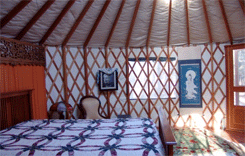 Finally,
for total decadence try the Yurt with Bathhouse.
Located on a separate parcel just 4 miles from Awakening Gardens, this is
special place. Built to house family and friends, this Yurt is now available
and priced at just $275 a weekend (in season plus a $30 cleaning fee). To truly
understand the beauty and luxury of this yurt with bathhouse you should look at
the tour to view each in the large format pictures and notice the beautiful
touches the DeNats have added to this experience. (How many bathhouses have a
sitting area and meditation space?) Take your time looking at this one.
Finally,
for total decadence try the Yurt with Bathhouse.
Located on a separate parcel just 4 miles from Awakening Gardens, this is
special place. Built to house family and friends, this Yurt is now available
and priced at just $275 a weekend (in season plus a $30 cleaning fee). To truly
understand the beauty and luxury of this yurt with bathhouse you should look at
the tour to view each in the large format pictures and notice the beautiful
touches the DeNats have added to this experience. (How many bathhouses have a
sitting area and meditation space?) Take your time looking at this one.
For addition information please call Carin DeNat at:(Cell) 845-706-0134 or email her at: info@awakeninggarden.com
One
of my favorite such couples are Mark and Carin DeNat who have created an
incredible country experience just 8 miles outside of Saugerties, NY called The Awakening Garden. You will get to know Mark and Carin pretty well
just from the beautiful way they have created this special place. Carin (who was born in China and came here
as a teen) is the gentle spirit that conceived and created this wonderful 98
acre site. The zen touches makes this a great place to breathe and retreat into
yourself. Mark, a retired NASDAQ guy is the assistant who helps to manage and
executes many of Carin's ideas adding his own special touches.
If you need a bit more space you might take a look at one of my favorites places, Thoreau'sCabin. Renting for $80 a night this cabin was made using many long saved recycled windows, doors and other materials, including beautiful stained glass. Spend the days under the tall tree canopy right outside your door, the evenings siting in front of the antique wood stove. With all the windows on this cabin you'll love the view.
Finally,
for total decadence try the Yurt with Bathhouse.
Located on a separate parcel just 4 miles from Awakening Gardens, this is
special place. Built to house family and friends, this Yurt is now available
and priced at just $275 a weekend (in season plus a $30 cleaning fee). To truly
understand the beauty and luxury of this yurt with bathhouse you should look at
the tour to view each in the large format pictures and notice the beautiful
touches the DeNats have added to this experience. (How many bathhouses have a
sitting area and meditation space?) Take your time looking at this one. For addition information please call Carin DeNat at:(Cell) 845-706-0134 or email her at: info@awakeninggarden.com
Friday, November 30, 2012
The Other Kind of Privacy- Property Postings
Although there are many reasons people move from the city to the country, some of the most common include the desire for a little elbow room and some privacy. I am always surprised when I found out what my real estate clients mean when I ask them to define both. When I lived in Manhattan “elbow room” was measured in small amounts of square feet and the difference between a large apartment and a small one could be as little as 100 square feet (just 10’ by 10’), and if you wanted privacy, forget about it. There is no such thing. The solution for some of us was to purchase a second home upstate.
I lucked out. The short story was that in 1985 I had two kids, a 3 and 5 year old who both needed to go to school in Manhattan. At least at that time this meant private school. With limited resources we went with a school in the village, Little Red on Sixth Avenue. No Dalton, but safe and reasonable. I used to call it “10 fingers and 10 toes.” (This meant I was relatively sure my kids would come home with the same amount of digits they left our loft with in the morning.) It costs $10,000 per kid per year back then. I have no idea what that would cost today. The bottom line was that we had purchased a vacation home with relatives upstate and while writing the check for the 1985-86 school year we decided we needed a big change. We bought out the other relatives (partners) and decided to go “Green Acres,” and in 1986 we sold our loft and moved permanently to East Durham, New York.
As I said, we lucked out. Our new home was at the end of a dead end road. It is 98 acres with two streams, a 1 acre pond and fully treed. Once we thinned some of our south facing trees we got awesome views of the mountains. Better yet we were surrounded by other large parcels so we have unbelievable privacy. Always looking ahead I started to research the best ways to reduce our taxes, knowing that this was going to be our biggest growing budget number. I didn't want to deal with ever increasing property taxes so I found out about Section 480-a of the tax code which allows for a large tax abatement if the landowner complied with an approved NYS forestry plan. New York State allows such a plan on parcels with 50 or more acres of wooded property. I’m saving a full explanation of this plan for a future post but if you are interested just follow this LINK and read about the process.
One of the requirements for this tax reduction plan involves the marking and posting of your property. Marking is easy. This means you would pick a symbol, mine are two horizontal blue lines, and paint the symbol on boundary trees. The posting requirement is a bit more involved. Whether you are posting for NYS Forestry reasons or just to keep others off your property, the requirements are the same. Below are the important steps and requirements for proper posting in New York State:
There are a few other things that might be helpful. The first is that you have no obligation to post. Anyone who trespasses is still legally a trespasser The property does not have to be posted to prosecute the offender, but it is much more likely that a judge will prosecute the offender if the property is properly posted. You may also post only a portion of your property. You can include language on the signs that require permission for entry. This serves multiple purposes. By giving permission to some people for some activities you will be in a better position if any adverse possession issues come up. It also lets the public know that if asked, permission might be granted.
One of the funniest things that has ever happened to me, and says something about the times we live in took place a few years ago. As I said, my property is very large with multiple streams. One of those streams has a series of waterfalls, one of which has over a 50 foot drop and is very dramatic. In the winter it is simply beautiful. One day a brand new Land Cruiser pulled up to my front door and a handsome, well dressed man got out and introduced himself as “almost” a neighbor. By “almost” he meant that his property bordered a parcel that bordered my property. After the introduction he asked me what I still consider to be the stupidest question I ever heard. “My wife and I love your property and walk it all the time. Can we buy your waterfall?”
At first I thought that he was kidding, but he wasn't Once I realized that he actually meant it, I told him “NO” and reminded him that he was trespassing and should ask permission if he ever wanted to enter it again. While this may seem like an un-neighborly thing to do, it wasn't It was simply protective. Whether the property is posted or not, the General Obligations Law protects landowners from liability for non-paying recreationalists on their property. Because of this protection, recreational liability lawsuits against rural landowners are uncommon, however this protection does not apply in cases of willful or malicious failure to guard or warn against dangers. The problem with this is that “willful or malicious failure to guard or warn against dangers” is not specific and is interpretable. A rope or dropped tree across a path on the property could be a viewed as a danger and as we have become a very litigious people, not something a landowner should take jokingly. Remember, some crazy woman successfully sued McDonald's for a scalding she claimed she got from a cup of hot coffee. I’d take no chances. Murphy’s Law is real and the best way to protect yourself is to protect your property rights. I will always give neighbors the right to walk my property, but do expect a call for permission. It would be best for you to protect yourself as well. Click here to download the "Ask Permission Slip" (26kb pdf).
I lucked out. The short story was that in 1985 I had two kids, a 3 and 5 year old who both needed to go to school in Manhattan. At least at that time this meant private school. With limited resources we went with a school in the village, Little Red on Sixth Avenue. No Dalton, but safe and reasonable. I used to call it “10 fingers and 10 toes.” (This meant I was relatively sure my kids would come home with the same amount of digits they left our loft with in the morning.) It costs $10,000 per kid per year back then. I have no idea what that would cost today. The bottom line was that we had purchased a vacation home with relatives upstate and while writing the check for the 1985-86 school year we decided we needed a big change. We bought out the other relatives (partners) and decided to go “Green Acres,” and in 1986 we sold our loft and moved permanently to East Durham, New York.
As I said, we lucked out. Our new home was at the end of a dead end road. It is 98 acres with two streams, a 1 acre pond and fully treed. Once we thinned some of our south facing trees we got awesome views of the mountains. Better yet we were surrounded by other large parcels so we have unbelievable privacy. Always looking ahead I started to research the best ways to reduce our taxes, knowing that this was going to be our biggest growing budget number. I didn't want to deal with ever increasing property taxes so I found out about Section 480-a of the tax code which allows for a large tax abatement if the landowner complied with an approved NYS forestry plan. New York State allows such a plan on parcels with 50 or more acres of wooded property. I’m saving a full explanation of this plan for a future post but if you are interested just follow this LINK and read about the process.
- You must own or have land use rights on the property to be posted.
- Signs must bear the name and address of the owner, lawful occupant or other person or organization authorized to post the area. The first names can be only initials (so mine simply say H&C Zucker) and the address need only be the town, not actual street address (so mine simply says East Durham, NY. My post office address is actually a different town, Cairo, but because the property is actually in East Durham my signs must say East Durham, not Cairo.)
- The sign must be at least 11” by 11” and the written part must take up at least 9” by 9” or 80% of the sign.
- The sign must bear a conspicuous statement which shall either consist of the word "POSTED" or warn against entry for specified purposes or all purposeswithout the consent of the person whose name appears on the sign.
- At least one sign must be set on each side of the protected area and on each side of all corners that can be reasonably identified. Signs should be no more than 660 feet apart, close to or along the boundaries of the protected area. Since the signs must be conspicuous, they should be high enough, and spaced closely enough to be seen. Please don't turn your property into an eyesore by using more signs than are necessary, although I do recommend that on street boundaries where the most trespassers may come from I shrink the distance and put signs every 200 to 300 feet.
- Signs must be maintained annually by the landowner.
One of the requirements for this tax reduction plan involves the marking and posting of your property. Marking is easy. This means you would pick a symbol, mine are two horizontal blue lines, and paint the symbol on boundary trees. The posting requirement is a bit more involved. Whether you are posting for NYS Forestry reasons or just to keep others off your property, the requirements are the same. Below are the important steps and requirements for proper posting in New York State:
There are a few other things that might be helpful. The first is that you have no obligation to post. Anyone who trespasses is still legally a trespasser The property does not have to be posted to prosecute the offender, but it is much more likely that a judge will prosecute the offender if the property is properly posted. You may also post only a portion of your property. You can include language on the signs that require permission for entry. This serves multiple purposes. By giving permission to some people for some activities you will be in a better position if any adverse possession issues come up. It also lets the public know that if asked, permission might be granted.
One of the funniest things that has ever happened to me, and says something about the times we live in took place a few years ago. As I said, my property is very large with multiple streams. One of those streams has a series of waterfalls, one of which has over a 50 foot drop and is very dramatic. In the winter it is simply beautiful. One day a brand new Land Cruiser pulled up to my front door and a handsome, well dressed man got out and introduced himself as “almost” a neighbor. By “almost” he meant that his property bordered a parcel that bordered my property. After the introduction he asked me what I still consider to be the stupidest question I ever heard. “My wife and I love your property and walk it all the time. Can we buy your waterfall?”
At first I thought that he was kidding, but he wasn't Once I realized that he actually meant it, I told him “NO” and reminded him that he was trespassing and should ask permission if he ever wanted to enter it again. While this may seem like an un-neighborly thing to do, it wasn't It was simply protective. Whether the property is posted or not, the General Obligations Law protects landowners from liability for non-paying recreationalists on their property. Because of this protection, recreational liability lawsuits against rural landowners are uncommon, however this protection does not apply in cases of willful or malicious failure to guard or warn against dangers. The problem with this is that “willful or malicious failure to guard or warn against dangers” is not specific and is interpretable. A rope or dropped tree across a path on the property could be a viewed as a danger and as we have become a very litigious people, not something a landowner should take jokingly. Remember, some crazy woman successfully sued McDonald's for a scalding she claimed she got from a cup of hot coffee. I’d take no chances. Murphy’s Law is real and the best way to protect yourself is to protect your property rights. I will always give neighbors the right to walk my property, but do expect a call for permission. It would be best for you to protect yourself as well. Click here to download the "Ask Permission Slip" (26kb pdf).
The Benefits of being a Green Landlord
Like every other business, residential property management has changed to match this new internet based business model that has become the new normal and while most real estate has yet to “come back” to the value of just a few years ago, apartments are one real estate asset that has keep it’s value. I would be lying if I didn't say that my real estate investments have been my most predictable income stream and the main reason this recession has been bearable. A few years ago I decided that I should take my own advice and Green up my apartament's and it may be the time for you to do the same. The process has three steps: greening the marketing/application process, greening the apartment painting and preparation area and finally making each unit and the building as a whole, more energy efficient.
The best part of greening the marketing and advertising section of your job is that it requires less work and is faster and simpler than the paper version of the same job. To start with, I’ll assume you are already marketing on Craigslist or some other online classified listing site. To fully take advantage of these sites remember that the busier the market, the more that is posted, the less face time your ad will have with the limited quality prospective tenants. That means that you need to refresh your listing every week by removing them and then replacing them with an updated version which will move your ad up the daily listings. Secondly, take advantage of the 4 pictures you are allowed to upload with your listing and take your time to show the best features of that particular apartment. If the building itself is impressive, use a picture of the building in the ad as well.
In your ad try to list all the information you want prospective tenants to know, leave nothing out. This information should include what would like to highlight about the apartment and building amenities, as well as any of the shortcomings that particular apartment might have. You might want to ask why would I tell you to include any of the negatives in the apartment but the reason should be obvious, if those negatives are going to bother the prospective tenant when they see the apartment, you would be better off not wasting time with that match. An example would be that I have a number of apartments with very small kitchens and I really can’t hide that. I know that anybody who does a lot of cooking is not to want one of those apartments and so it would be wise for me to tell prospective tenants because I know that for many people, a small kitchen is unimportant. Any correspondence with the prospective tenant can be used as a filtering device.
Now that you’ve limited the wrong tenants and found a needs matching potential tenant try to continue to keep the process electronic. I create all my applications, disclosures, and blank lease forms in Google docs so that I can simply “share” these documents with my potential tenant. I have them email me permission to run a credit check and return the documents with this “sharing” once they credit check comes back as a go-ahead. This takes care of my legal position in running a credit check and also verify their email address and contact information. I then ask them if the lease is acceptable and then to either scan the documents and email back to me as a .pdf file or mail to hard copies via snail mail to my office address. I then can send them back a fully executed lease, also as a .pdf file.
Included in my application process is the requirement for an e-mail address and a cell phone number and permission to use text messages and email as the default communication method. Once completed I know I can communicate with my tenant with a minimum of effort.
The second part of the Greening process is all the work in the apartment itself. I include three separate areas in this process. The first is cleaning, the second painting and the third is windows and appliances. For anybody who has followed my posts this year there should be at least a few related to using non-toxic, biodegradable, natural cleaning products so I won’t go into that right now. These products were named and linked in my 11/6/12 post. Using these natural products will not only save you money but will give you a giant marketing advantage in marketing your apartments as Green.
As most apartments get painted at least every three years so it’s important to know that almost all of the major paint manufacturers have a line of either no VOC’s or low VOCs. (VOC’s are Volatile Organic Compounds, which are gases that may have both short and long term health issues. These new paint’s have about a 10% premium in pricing but have two major advantages in usage. The first is there is no smell from the paint (it’s the smell that are those chemicals) and so it is both pleasant to paint as well as a nice for the tenant moving in to not have that “latex” smell in the apartment. The second advantage is the ability to market the apartment to a progressive thinking tenant. Landlords sometimes have a view of their tenants that does not match reality. We sometimes use reverse-discrimination and believe that only high income tenants care about environmental air quality but from real-life experience I can tell you that this is not the case. While you may not be able to get a higher rent from low income tenants you will get a better quality tenant from Greening even your least expensive apartment.
A few more suggestions:
Use only one interior color in painting all apartments. This means ceilings, walls and woodwork will get one color.
Pick a color that is neutral, that you think anyone would like and make that the color of every apartment in that property. I use either Benjamin Moore Linen White or Benjamin Moore Antique White. All other paint manufacturers will match either of those colors. Since 2011 almost all of the paint manufacturers have gone to low VOC paint formula as well as having a VOC free version.
At least once a year, or maybe once the lease is signed with the new tenant, the tenant will ask you if they can paint one room, or in some cases a more than one room a different color. Your answer should always be no. (If you absolutely have to give in you should add an amount equal to two times the cost of repainting the apartment as additional security deposit.)
Use either flat or eggshell on ceilings and walls and semigloss or gloss for all woodwork.
Use only one interior color in painting all apartments. This means ceilings, walls and woodwork will get one color.
Pick a color that is neutral, that you think anyone would like and make that the color of every apartment in that property. I use either Benjamin Moore Linen White or Benjamin Moore Antique White. All other paint manufacturers will match either of those colors. Since 2011 almost all of the paint manufacturers have gone to low VOC paint formula as well as having a VOC free version.
At least once a year, or maybe once the lease is signed with the new tenant, the tenant will ask you if they can paint one room, or in some cases a more than one room a different color. Your answer should always be no. (If you absolutely have to give in you should add an amount equal to two times the cost of repainting the apartment as additional security deposit.)
Use either flat or eggshell on ceilings and walls and semigloss or gloss for all woodwork.
The last step greening your apartment building is to make each unit as energy efficient as possible. If you are here in the Northeast that means that the biggest bang for the buck is in weatherizing. On a purely selfish level most of the appliances may be owned by you but the electrical usage is billed to the tenant so while you may want to modernize the apartment (for rental reasons) with a new refrigerator, your best return on investment will be in saving money in heating costs. The more you keep the utility costs down, the more you make. On a per apartment basis the bulk of the heat lost in each apartment is due to the windows (and window frames) and exterior electrical outlets. The exterior electrical outlets can be insulated easily by purchasing electrical outlet insulator’s at your local hardware store. They are typically sold in packs of 10 for $1.99. Best two bucks you’ll ever spend.
The windows and window frames are not so simple. First you need to access the situation. What type and the age of the windows are is important. Most home or apartment windows are called double hung and have a movable lower and upper pane and are either single pane or double pane (sometimes called an insulated window.) If your windows are relatively new and are double pane windows you need go no further. However if these are the older single pane windows the next question would be “Is there a storm window outside this window?” If there is a storm window all we would need to do is to make sure it was working properly. If there are no storm window’s then the option would be to either completely replace the window’s (with a cost of $250-$500/window), put on a storm window (with a cost of $65-$100/window) or install an interior storm (with a cost of $100/window.)
I can’t tell you which is best for you. The return on investment is only one part of the equation.
New windows also have a marketing value in addition to saving you operating expenses. Certainly if you can afford to replace the old windows this would be your best choice, however almost as important as the windows is the frame the window is sitting in. In most cases the window itself was put into a frame with a quarter inch gap on all sides (called a rough opening). The window was then shimmed and nailed. The gap was then filled with fiberglass insulation and then trimmed out and painted. In most cases even if it’s a new window it might have been installed this way. The best thing to do then is to take off the casement trim on the window and see if the insulation is fiberglass or foam. if the insulation is foam you can close it up and be happy you have a well sealed house. However if it is fiberglass insulation you will need to remove the insulation and replace with non-expanding foam. (Expanding foam would ruin the window so make sure the foam you purchase is non-expanding.)
New windows also have a marketing value in addition to saving you operating expenses. Certainly if you can afford to replace the old windows this would be your best choice, however almost as important as the windows is the frame the window is sitting in. In most cases the window itself was put into a frame with a quarter inch gap on all sides (called a rough opening). The window was then shimmed and nailed. The gap was then filled with fiberglass insulation and then trimmed out and painted. In most cases even if it’s a new window it might have been installed this way. The best thing to do then is to take off the casement trim on the window and see if the insulation is fiberglass or foam. if the insulation is foam you can close it up and be happy you have a well sealed house. However if it is fiberglass insulation you will need to remove the insulation and replace with non-expanding foam. (Expanding foam would ruin the window so make sure the foam you purchase is non-expanding.)
There will always be more to do when winterizing your apartment building and the apartments within. If the apartment has it’s own thermostat, switching to a programmable EnergyStar® thermostat will help. Once your improvement’s are made your marketing can begin. You will be amazed at the results of simply adding Green to your marketing campaign. Good luck. If you do it right, it will mean more green in your pocket.
Subscribe to:
Posts (Atom)